The Economics of SaaS Boilerplates: A Quantitative Case for Buying Your Foundation
A quantitative analysis of SaaS Boilerplates. Compare the $15k+ cost of building vs the efficiency of buying. Master your capital allocation and market velocity in 2025.

Written by Rafael Jaén
•8 min read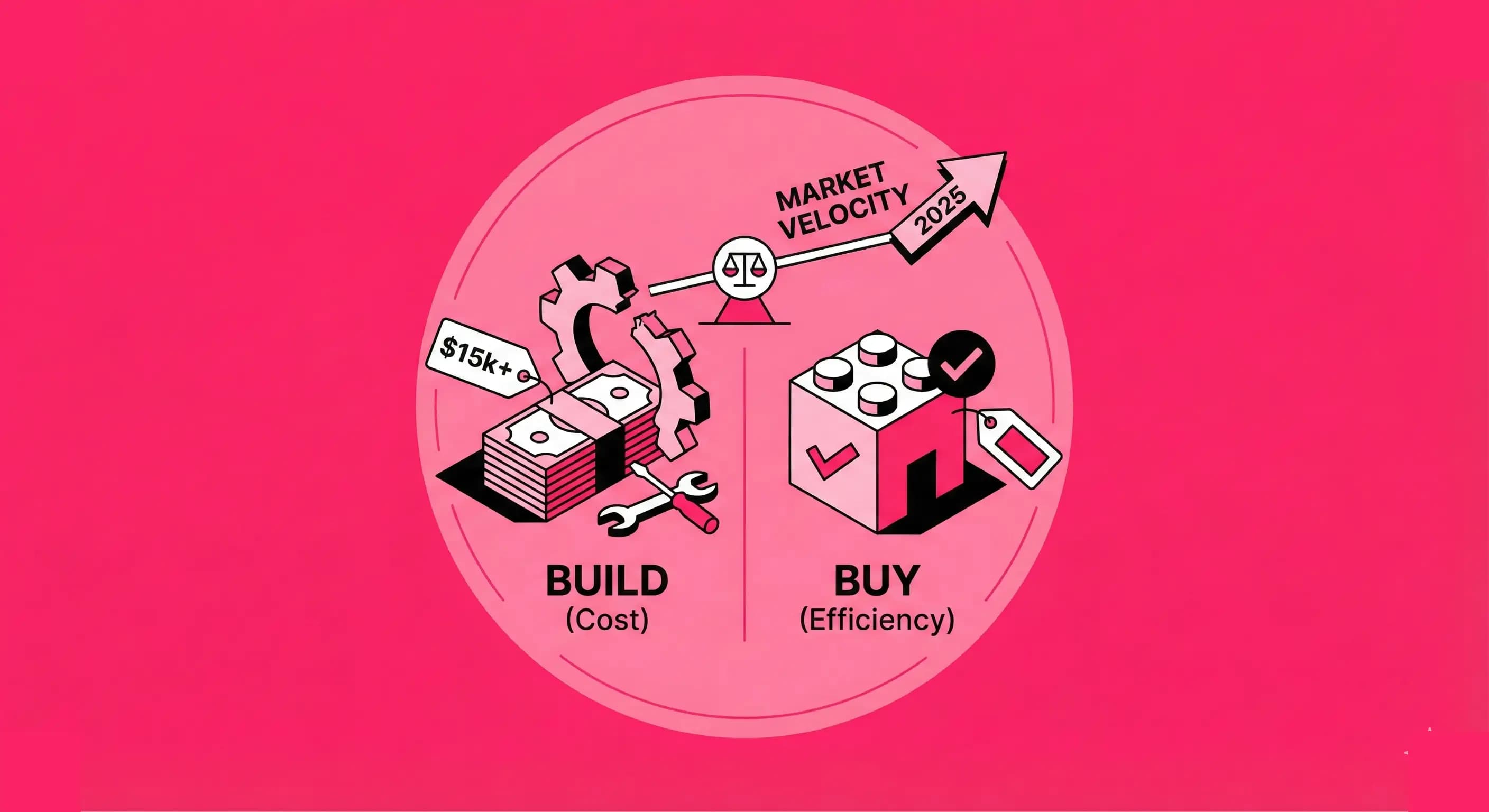
The hard truth for any technical founder is that the clock is always running, and every tick carries a significant cost. With senior developer time commanding rates from $80 to over $200 per hour, the decision of where to allocate this finite, expensive resource becomes the single most critical factor in a startup's trajectory.
This decision is governed by the principle of Opportunity Cost: the value of the next-best alternative forgone. For a SaaS startup, time spent building foundational "plumbing"—authentication, payment processing, user management—is a direct trade-off against market validation, customer acquisition, and iterating on the core value proposition.
This is the primary capital allocation error for early-stage startups: investing precious capital in solving problems that are already solved, while the real business risks go unaddressed.
This analysis will quantitatively deconstruct the "build vs. buy" decision for SaaS infrastructure. By examining direct labor costs, hidden development hours, and long-term maintenance burdens, we will demonstrate why purchasing a commercial boilerplate is not a shortcut, but rather the most rational economic choice for maximizing development velocity.
The Financial Framework: Quantifying the Initial "Setup Tax"
Before dissecting the technical complexity of modern SaaS applications, it is critical to establish a clear financial baseline. This section moves beyond abstract concepts to provide a concrete, data-driven comparison of the direct costs associated with building foundational infrastructure versus purchasing a pre-built solution.
By using objective market data on developer labor, we can quantify the immediate financial impact of the "build vs. buy" decision. This is the visible tip of the iceberg—the true, submerged costs that sink startups lie in the hidden hours we will analyze next.
Developer Labor as a Primary Cost Metric
The primary expenditure in any software build is human capital. Global hourly rates for developers vary, but the economic principle remains consistent. The following table synthesizes current market data, illustrating the cost of the talent required to build production-grade software from the ground up.
| Region | Junior Developer Hourly Rate | Senior Developer Hourly Rate | Specialized (AI/Sec) Rate |
|---|---|---|---|
| North America (USA) | $50 - $80 | $120 - $200+ | $100 - $250 |
| Western Europe | $40 - $70 | $100 - $150+ | $90 - $200 |
| Eastern Europe | $25 - $50 | $80 - $120 | $70 - $150 |
| Asia (India/PH) | $12 - $35 | $60 - $100 | $50 - $130 |
| Latin America | $20 - $45 | $70 - $110 | $60 - $140 |
The Direct Cost Calculation: 40 Hours vs. a Single Purchase
Even a minimal application "skeleton" requires significant effort. A senior developer spending just one week (40 hours) on initial infrastructure setup—including authentication, database connections, and deployment scripts—represents a direct cost to the business. Using a conservative rate of $80/hour, this initial build costs:
Cost_Build = $80/hour * 40 hours = $3,200
In stark contrast, the price for a high-quality, production-ready commercial boilerplate for an MVP typically ranges from $99 to $499. While more comprehensive enterprise-grade starter kits can command prices up to $1,499, their return on investment remains overwhelmingly positive when compared to the $64,000+ cost of building a similar foundation manually.
The calculation for an MVP-focused boilerplate is straightforward: for a $3,200 build cost, a $99 purchase represents a 96.9% saving, while a $499 purchase saves 84.4%. The boilerplate pays for itself within the first few hours of a senior developer's time, freeing up the remaining capital for development focused on the core product.
Technical Deconstruction: The Hidden Hours in Foundational Plumbing
To truly understand the economic value of a boilerplate, one must dissect the common, non-differentiating features that consume hundreds of development hours. These components are "solved problems" in the SaaS industry; rebuilding them is not only inefficient but also introduces unnecessary technical and security risk.
Identity & Access Management: The 100-Hour Security Sinkhole
Authentication and authorization are consistently the most underestimated development phases. Modern users expect a seamless and secure identity experience, including Social OAuth (Google, Apple), passwordless magic links, and Multi-Factor Authentication (MFA). As multiple industry analyses confirm, the difference between a simple signup form and a production-grade identity system is approximately 40 hours of senior development time.
| Auth Feature Component | Estimated Implementation Time (Senior) | Complexity Score (1-10) | Risks of Manual Error |
|---|---|---|---|
| Base Auth (Email/Pass) | 20 - 30 Hours | 6 | Plaintext storage, weak hashing. |
| Social OAuth Providers | 10 - 20 Hours | 7 | Callback misconfiguration, CSRF. |
| MFA / 2FA Flows | 15 - 25 Hours | 8 | Account lockout loops, recovery code flaws. |
| Session/JWT Strategy | 15 - 25 Hours | 9 | Token leakage, improper expiration. |
| RBAC Logic | 20 - 25 Hours | 7 | Privilege escalation vulnerabilities. |
| Total | 80 - 125 Hours | High | Foundational Security Risk |
Transactional Infrastructure: The Gauntlet of Payment Webhooks
Integrating a payment gateway like Stripe for a recurring revenue model is far more complex than a single API call. The primary challenge lies in the asynchronous management of the subscription lifecycle via webhooks. A production-ready system must handle hundreds of potential events to keep the application's database synchronized with the payment provider. Building this resilience from scratch is a significant undertaking estimated to take 30 to 60 hours of senior developer effort.
Key implementation requirements include:
- Idempotency: Designing logic to ensure that if a webhook is received multiple times (a common occurrence), the user's subscription status is only updated once.
- Graceful Failures: Building automated workflows to handle events like
invoice.payment_failed, which trigger dunning emails and eventually revoke access. - Trial and Proration Logic: Accurately calculating charges when users upgrade, downgrade, or cancel mid-cycle.
- Secure Webhook Handling: Verifying webhook signatures to prevent fraudulent requests from malicious actors.
UI Architecture: The Unseen Cost of Admin and User Panels
The market systematically underestimates the engineering cost of internal UIs, viewing them as simple component assembly rather than a distinct application layer. In reality, building responsive, data-driven admin and user panels requires a coherent component architecture, robust data fetching logic, state management, and meticulous attention to mobile responsiveness. Senior developers often spend 60 to 100 hours creating just the initial versions of these essential interfaces.
Common UI tasks and their estimated senior developer time include:
- Sidebar & Navigation: 8 - 12 Hours
- Data Tables & Filtering: 12 - 20 Hours
- Forms & Validation: 12 - 18 Hours
Lifecycle Communications: The Hidden Tax of Email Deliverability
Transactional emails—welcome messages, password resets, billing updates—are critical for user engagement and retention. However, their implementation is fraught with technical challenges that are often overlooked. A proper implementation requires approximately 20 to 40 hours of focused effort.
Technical challenges include:
- Responsive HTML: Designing and coding emails that render consistently across dozens of inconsistent email clients like Outlook and Gmail.
- Service Integration: Wiring the application backend to a transactional email service. Boilerplates often come pre-configured with services like Resend and templates built with React Email.
- DNS Authentication: Correctly configuring SPF, DKIM, and DMARC records to ensure emails land in the user's inbox, not their spam folder.
The Strategic Misalignment: Your Code Is a Cost, Not The Product
The analysis must now shift from technical details to strategic principles. For many technical founders, there is a psychological trap: the belief that the quality and elegance of their infrastructure code is, in itself, a competitive advantage. This perspective fundamentally misinterprets what a customer is buying.
The core argument is this: The code is the cost; the solution is the product.
Users do not care about the architecture of your authentication system or the efficiency of your Stripe webhook handler. They care about whether your software solves their pain point, saves them time, or generates them money. Every hour and every dollar spent on reinventing foundational plumbing is capital that cannot be spent on the activities that actually drive business value.
Instead of foundational development, capital and time should be allocated to high-value activities that directly impact key SaaS metrics:
- Customer Development: Speaking with potential users to validate the core problem, a process that directly reduces future churn and increases Net Revenue Retention (NRR).
- Marketing and SEO: Initiating the content and backlinking strategy required for organic search, which often has a 3-9 month ramp-up time before delivering consistent, low-cost traffic and reducing the long-term Customer Acquisition Cost (CAC).
- Note: This involves earning authoritative backlinks from industry publications and review platforms like Capterra to build long-term domain authority.
- Sales and Distribution: Building a sales pipeline concurrently with product refinement to shorten the time to first revenue.
Every hour spent on solved problems is a strategic loss. It directly delays market validation, extends the time to profitability, and cedes ground to competitors who are focused on shipping, not on building a perfect infrastructure from scratch.
Total Cost of Ownership (TCO): The Long Tail of Custom Maintenance
The cost of software does not end at deployment. A critical metric for evaluating the "build" decision is the Total Cost of Ownership (TCO), which accounts for the ongoing expenses required to maintain, update, and secure the application over its lifecycle.
A widely accepted industry benchmark for annual software maintenance is 15-25% of the initial development expense. This figure covers bug fixes, security patching, dependency updates, and minor feature enhancements. For a custom MVP built at a cost of $25,000, this translates to an additional $3,750 - $6,250 per year. Over a five-year period, the TCO for that MVP can escalate to $50,000 or more.
This contrasts sharply with the "shared maintenance" model inherent in a commercial boilerplate. The boilerplate provider distributes the maintenance burden of adapting to third-party API changes, patching security vulnerabilities, and updating dependencies across hundreds or thousands of customers. Leading boilerplates such as ShipFast or MakerKit have active communities and release regular updates, socializing the cost of maintenance.
| Factor | Custom Software (Build) | Boilerplate (Buy) |
|---|---|---|
| Upfront Cost | High ($10,000 - $50,000) | Low ($100 - $500) |
| Deployment Time | 3 - 6 Months | 1 - 2 Weeks |
| Maintenance | 15-25% of initial cost / year | Minimal (Update merging) |
| Scalability | Challenging (Requires resources) | Built-in (Usually) |
| Flexibility | Unlimited | Moderate (Opinionated) |
How Generative AI Changes the Calculation
A common counter-argument is that modern AI coding assistants can generate foundational code for free, rendering boilerplates obsolete. While tools like GitHub Copilot have undeniably accelerated development, they have not eliminated the value of a curated, pre-integrated boilerplate. AI-generated code is a powerful starting point, but it is not a complete, production-ready system.
Expert consensus suggests that transforming AI-generated snippets into a cohesive application requires 10 to 20 hours of senior-level effort for orchestration, validation, and refinement. A more granular, user-level analysis from a developer on Reddit quantifies this new cost structure: recreating a boilerplate with AI costs approximately "$20 to $30" in token fees plus "seven to eight hours of my own time fixing wiring."
The economic conclusion is clear: even with AI, the "build" cost is not zero. It transforms into a quantifiable expense of (Tokens + Senior Dev Validation Time), which still significantly exceeds the purchase price and immediate utility of a commercial boilerplate. A boilerplate remains a superior starting point because it offers a human-curated and pre-validated architecture—a level of reliability and coherence that a fragmented set of AI-generated snippets has yet to achieve.
The Decision Matrix: Build vs. Buy at a Glance
This table provides a high-level summary of the key trade-offs, designed to aid in rapid, strategic decision-making.
| Factor | Build from Scratch | Buy a Boilerplate |
|---|---|---|
| Time-to-Market | 3-6+ months for an MVP. | 1-4 weeks to first deployable version. |
| Upfront Capital Outlay | High (tens of thousands in developer salary). | Low (typically under $500, one-time). |
| Long-Term Maintenance Cost | High (15-25% of initial build cost, annually). | Low (shared maintenance via boilerplate updates). |
| Resource Allocation Focus | Building foundational, non-differentiating features. | Building the core value proposition and unique features. |
| Architectural Control | Total control, for better or worse. | Opinionated but extensible; constrained by the boilerplate's choices. |
| Initial Security Risk | High; dependent on the in-house team's security expertise. | Low; relies on battle-tested, community-vetted patterns. |
| Scalability Path | Must be custom-architected, introducing risk and cost. | Often built-in, following established best practices. |
Conclusion: The Mandate for Shipping
The quantitative evidence is unequivocal: for the vast majority of startups, building foundational SaaS infrastructure from scratch is an economically irrational choice.
It consumes the two most precious resources an early-stage company has—time and capital—on activities that create no competitive differentiation and actively delay market validation. Every hour spent rebuilding authentication is a direct and quantifiable opportunity cost—an hour not spent speaking to a customer, closing a sale, or shipping a feature that commands a higher price.
Founders must treat the "skeleton" of a modern SaaS application as a commodity to be acquired, not an engineering challenge to be solved. The economic mandate is clear: allocate capital to the unique value proposition, not the commoditized foundation.
Stop building the plumbing; start building the business.